

A commercial refrigerator that stops cooling properly can cause serious problems for a business. Food may spoil, drinks may become warm, and valuable stock can be lost. When this happens, many business owners assume the refrigerator needs more Freon.
But How to Add Freon to a Commercial Refrigerator is not simply a matter of connecting a gas cylinder and filling the system.
Commercial refrigerators use specific refrigerants in sealed cooling systems. If refrigerant levels are low, there may be a leak that needs repairing. Adding more gas without finding the problem can lead to repeated breakdowns, higher energy bills, and expensive compressor damage.
The safest solution is to have the refrigerator inspected by a qualified refrigeration engineer.
At Birmingham Refrigeration & Air Conditioning, we provide professional refrigeration repairs, fault diagnosis, and refrigerant leak detection for businesses throughout Birmingham and the West Midlands.
This guide explains how commercial refrigeration charging works, why refrigerant leaks happen, what signs to look for, and when to arrange professional help.
How to Add Freon to a Commercial Refrigerator
Understanding How to Add Freon to a Commercial Refrigerator starts with knowing that refrigerant charging is a technical job.
Commercial refrigerators are designed to operate with a particular type and quantity of refrigerant. The correct amount is normally specified by the manufacturer.
A qualified refrigeration engineer begins by checking the condition of the refrigerator. They examine the cooling performance, operating temperatures, compressor, pipework, and other important components.
If refrigerant loss is suspected, the engineer checks for leaks before deciding whether charging is necessary.
The professional process generally involves identifying the correct refrigerant, investigating any leak, carrying out necessary repairs, checking that the sealed system is sound, and restoring the correct refrigerant charge using approved equipment.
The engineer then checks that the refrigerator is operating correctly.
Refrigerant should never be added simply because the refrigerator feels warm.
A faulty thermostat, blocked condenser, damaged door seal, or broken fan can cause similar symptoms.
For business owners, the best first step is professional commercial refrigeration repair in Birmingham rather than attempting to add refrigerant yourself.
What people mean when they say Freon
Freon is a well known trade name associated with certain refrigerants. Over time, people have started using the word Freon to describe almost any gas used in refrigerators and air conditioning systems.
However, not every commercial refrigerator contains Freon.
Different refrigerators use different types of refrigerant, including R134a, R404A, R448A, R449A, R290, and R744.
Some are commonly found in older systems, while others are used in more modern commercial equipment.
Each refrigerant has different operating properties and safety requirements.
For example, R290 is propane, a refrigerant that is flammable and requires particular care during servicing.
When researching How to Add Freon to a Commercial Refrigerator, it is important to understand that the actual refrigerant type matters much more than the general name Freon.
You can learn more about the different types through this Wikipedia guide to refrigerants.
How commercial refrigerant systems work
Commercial refrigerators remove heat from the storage compartment and release it into the surrounding environment.
This happens through a refrigeration cycle involving four main components.
Compressor
The compressor circulates refrigerant through the system and increases its pressure and temperature.
Condenser
The condenser releases heat from the refrigerant into the surrounding air. A dirty condenser can make the refrigerator work harder.
Expansion device
The expansion device controls refrigerant flow and reduces its pressure before it enters the evaporator.
Evaporator
The evaporator absorbs heat from inside the refrigerator, helping keep food and drinks cold.
These components work together in a closed system.
Unlike petrol in a vehicle, refrigerant is not supposed to be regularly consumed during normal operation.
This is an important point for anyone learning How to Add Freon to a Commercial Refrigerator. A properly functioning sealed refrigeration system should not require routine refrigerant top ups.
Signs of a possible refrigerant problem
A commercial refrigerator can develop several symptoms when its refrigerant charge becomes too low.
However, these signs do not automatically confirm a refrigerant leak.
Refrigerator is not cooling properly
One common warning sign is poor cooling. The refrigerator may continue running but struggle to reach its normal temperature.
Compressor runs continuously
A refrigerator that runs for unusually long periods may be struggling to remove heat. Low refrigerant is one possible cause, but dirty coils and other faults can produce the same result.
Unusual frost or ice formation
Ice appearing in unexpected places may indicate an airflow problem, defrost fault, or refrigerant issue.
Rising energy bills
A refrigerator that works harder than normal may consume more electricity.
Temperature fluctuations
If the cabinet temperature rises and falls unexpectedly, the system may not be operating correctly.
Before assuming refrigerant is low, check the temperature setting, door seals, visible ventilation openings, and whether the door closes properly.
If the problem continues, arrange professional refrigeration fault finding.
These checks help determine whether How to Add Freon to a Commercial Refrigerator is even the right question for the problem.
Why low refrigerant can indicate a leak
Commercial refrigeration equipment normally operates as a sealed system.
This means refrigerant circulates inside the pipework rather than being used up over time.
If the system has lost refrigerant, there is usually a reason.
Leaks may develop because of vibration, corrosion, worn connections, damaged pipework, or ageing components.
Sometimes a very small leak causes cooling performance to deteriorate gradually. In other cases, a damaged pipe or component can cause a more noticeable loss.
Simply adding more refrigerant does not repair the leak.
The refrigerator may work temporarily before the refrigerant escapes again.
Repeated charging can increase operating costs and allow a mechanical problem to become worse.
The proper solution is to identify and repair the leak before restoring the refrigerant charge.
Our refrigerant leak detection and repair service helps Birmingham businesses investigate these problems.
Identifying the correct refrigerant
One of the most important parts of How to Add Freon to a Commercial Refrigerator is identifying the correct refrigerant.
Different refrigerants are not automatically interchangeable.
Using the wrong type can damage the cooling system, create unsafe operating conditions, or cause poor performance.
Most commercial refrigerators have a manufacturer information plate or label.
This usually provides the appliance model, serial number, refrigerant designation, and original refrigerant charge.
The charge may be stated in grams or kilograms.
For example, a refrigerator might have a label showing R290, while an older model might specify R134a.
These refrigerants have very different characteristics.
The refrigerant label should never be ignored, and a different refrigerant should not be substituted without a properly approved conversion.
If the label is missing or unreadable, a refrigeration engineer can investigate the appliance specifications before carrying out work.
Why refrigerant charging is not a simple DIY job
Many people searching for How to Add Freon to a Commercial Refrigerator are hoping to find a quick repair they can complete themselves.
Unfortunately, refrigerant charging involves risks that ordinary refrigerator maintenance does not.
Refrigeration systems operate under pressure. Incorrect handling can cause injury, including cold burns from escaping refrigerant.
Some refrigerants are flammable. Others can displace oxygen in poorly ventilated spaces.
Incorrect charging can also damage the compressor or cause the system to operate outside its intended limits.
Specialist training and equipment are needed to identify the fault, handle refrigerant safely, and restore the correct charge.
UK regulations also restrict who can carry out work involving fluorinated refrigerants.
Business owners can safely check accessible controls and arrange routine cleaning according to the manufacturer’s instructions.
However, opening the sealed refrigeration circuit or adding refrigerant should be left to a suitably qualified professional.
Equipment used by refrigeration engineers
Professional refrigeration engineers use specialist equipment to diagnose and repair commercial cooling systems.
The tools used depend on the refrigerant, refrigerator design, and type of fault.
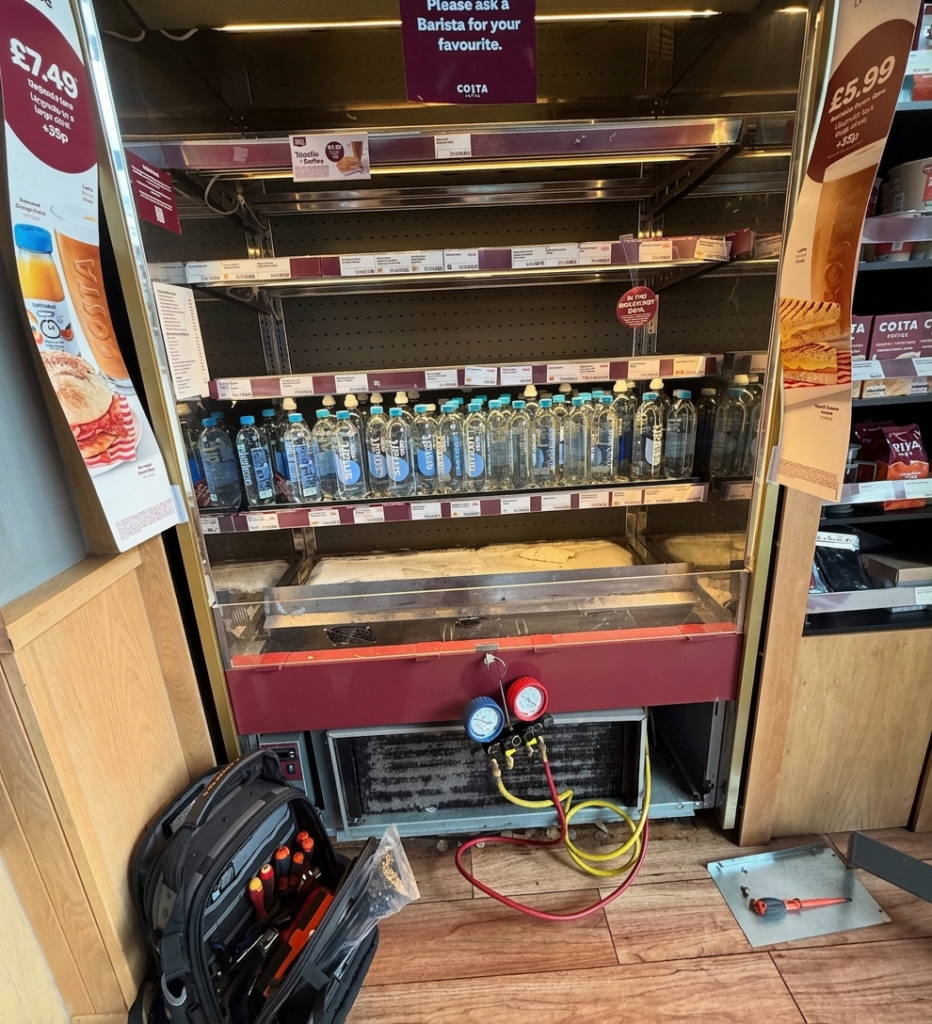
Refrigeration gauges
These help engineers assess refrigerant pressures and investigate system operation.
Pressure readings must be interpreted alongside other measurements rather than used alone to decide the required refrigerant quantity.
Refrigerant weighing scales
Accurate scales help engineers measure refrigerant quantities where charging by weight is specified.
Electronic leak detectors
These instruments help identify escaping refrigerant from pipework, connections, and components.
Refrigerant recovery machines
Recovery equipment allows suitable refrigerants to be collected rather than deliberately released into the atmosphere.
Vacuum pumps
Vacuum pumps are used during appropriate service procedures to remove air and moisture from the sealed system.
Temperature measuring instruments
Engineers use thermometers and probes to check operating temperatures and assess cooling performance.
Knowing about this equipment helps explain How to Add Freon to a Commercial Refrigerator safely, but using it correctly requires professional training and experience.
Refrigerant leak detection
Finding a refrigerant leak is often more important than adding gas.
A refrigerator may lose refrigerant slowly for weeks before the cooling problem becomes obvious.
Professional refrigerant leak detection begins with an inspection of the system and its operating condition.
Engineers may examine pipe connections, coils, joints, and areas showing signs of damage or corrosion.
Depending on the system, they may use electronic detection instruments or appropriate pressure testing methods.
Small leaks can be difficult to locate because they may only appear under certain operating conditions.
A proper inspection helps distinguish refrigerant loss from other problems, such as a faulty fan or blocked condenser.
If you have been searching for How to Add Freon to a Commercial Refrigerator because the same refrigerator keeps losing cooling performance, leak detection should be a priority.
Repeatedly adding gas without fixing the cause can waste money and leave your business facing another breakdown.
What happens after a refrigerant leak is found
Once a refrigerant leak has been located, the engineer assesses the damage and decides how it should be repaired.
The appropriate repair depends on the condition of the equipment and the location of the leak.
A damaged connection might be repairable, while a corroded coil may require replacement.
If necessary, refrigerant is recovered using suitable equipment before the repair work.
After the faulty area has been repaired, the system is checked to confirm that it is sound.
Where required, air and moisture are removed before the correct refrigerant charge is restored.
The engineer then tests cooling performance and checks the system for safe operation.
For systems covered by UK F gas leak check rules, a follow up check is required within one month after a leak repair.
This is why How to Add Freon to a Commercial Refrigerator involves much more than putting additional refrigerant into the appliance.
A proper repair addresses the reason the refrigerant was lost.
Refrigerant regulations and safe handling
Commercial refrigeration work in Birmingham must follow applicable UK safety and environmental rules.
Refrigerants can affect the environment if released incorrectly. Some types also present fire or health risks.
UK F gas regulations
Fluorinated refrigerants are covered by UK F gas rules.
Individuals carrying out regulated work on equipment containing F gas must hold the appropriate qualifications.
Companies servicing F gas refrigeration equipment operated by other businesses must also hold the relevant company certification.
You can read the UK government guidance on F gas qualifications for further information.
Safe refrigerant recovery
Refrigerant that needs to be removed must be handled using suitable recovery procedures.
It should not be deliberately released into the atmosphere.
Recovered refrigerant must be managed according to the applicable rules.
Flammable refrigerants
Refrigerants such as R290 require special precautions because they are flammable.
Although hydrocarbon refrigerants are not covered by F gas certification requirements in the same way as fluorinated gases, technicians still need suitable competence, training, and equipment.
Following these rules protects workers, customers, premises, and the environment.
Why overcharging a refrigeration system is dangerous
Adding too much refrigerant can be just as damaging as operating a system with too little.
An overcharged commercial refrigerator may develop excessive operating pressures, reduced efficiency, or abnormal compressor temperatures.
In some circumstances, excess liquid refrigerant can reach parts of the system where it may damage the compressor.
An overcharged system can also consume more electricity while delivering poor cooling performance.
This is why guessing the correct quantity is unsafe.
A qualified engineer considers the manufacturer’s specifications and the system’s operating condition before charging.
Understanding How to Add Freon to a Commercial Refrigerator also means knowing when to stop.
More refrigerant does not automatically produce better cooling.
When professional refrigeration repair is needed
A commercial refrigerator should be inspected when it stops maintaining the correct temperature, runs continuously, develops unusual noises, or repeatedly shows signs of a cooling fault.
You should also arrange help if the refrigerator trips electrical protection devices or shows visible signs of damage.
For food businesses, the consequences can be particularly serious.
The Food Standards Agency recommends keeping chilled food storage equipment at 5°C or below. In England, food that legally requires chilled storage must generally be kept at 8°C or below, subject to relevant exceptions.
If a refrigerator cannot maintain safe storage temperatures, assess the food and move stock to suitable working refrigeration where appropriate. Follow your food safety procedures rather than assuming the contents remain safe.
An engineer can check whether the fault involves refrigerant, airflow, electrical controls, the compressor, or another component.
For urgent problems, our refrigeration emergency callout service is available to Birmingham businesses.
Commercial refrigeration engineers in Birmingham
When refrigeration stops working, businesses need the problem identified and repaired properly.
Birmingham Refrigeration & Air Conditioning provides commercial refrigeration services for restaurants, cafés, takeaways, supermarkets, pubs, hotels, shops, and commercial kitchens.
Our services include refrigeration repairs, refrigerant leak detection, system diagnostics, servicing, maintenance, and commercial refrigeration installation.
We work with different types of equipment, including commercial fridges, display chillers, bottle coolers, cold rooms, and freezers.
Our Birmingham based service covers surrounding areas of the West Midlands, including Solihull, Sutton Coldfield, West Bromwich, Dudley, and Walsall.
Why choose Birmingham Refrigeration & Air Conditioning?
Our service focuses on identifying the actual fault instead of automatically assuming the appliance needs more refrigerant.
Our website highlights work carried out by F gas qualified engineers, along with experience in commercial refrigeration systems.
Whether your refrigerator needs leak detection, a component repair, or an assessment of refrigerant charging, we can help you find the appropriate solution.
If you are still wondering How to Add Freon to a Commercial Refrigerator, contact our team before attempting to handle the refrigerant yourself.
Need expert commercial refrigerator repair in Birmingham?
Visit Birmingham Refrigeration & Air Conditioning or contact our refrigeration team to discuss the fault and request a quote.
Frequently asked questions
Can I add Freon to a commercial refrigerator myself?
Refrigerant charging should be carried out by a suitably qualified professional. It involves pressurised equipment, specific refrigerants, specialist tools, and safety requirements. Work involving fluorinated refrigerants is also subject to UK qualification rules.
How do I know if my commercial refrigerator needs Freon?
Poor cooling, long running periods, and unusual frost patterns may indicate a refrigerant problem. However, the same symptoms can result from blocked condensers, damaged door seals, faulty fans, or electrical issues. Professional diagnosis is needed to confirm refrigerant loss.
How often should a commercial refrigerator need refrigerant?
A properly sealed refrigerator should not require regular refrigerant top ups. If refrigerant needs to be added repeatedly, the system may have a leak that requires investigation.
How much Freon should be added to a commercial refrigerator?
The correct quantity depends on the particular refrigerator and its refrigerant specifications. Manufacturers normally state the intended charge on the equipment label. Adding refrigerant without confirming the correct amount can damage the system.
Can I use any refrigerant in my commercial refrigerator?
No. Refrigerants have different chemical properties, operating pressures, and safety classifications. Only the refrigerant specified by the manufacturer, or an officially approved alternative following the correct conversion procedure, should be used.
How long does commercial refrigerator refrigerant charging take?
The time depends on the refrigerator, the condition of the system, and whether a leak or other fault needs repairing. A simple assessment may be relatively quick, while locating and repairing a difficult leak can take much longer.
Why is my commercial refrigerator still warm after adding refrigerant?
The refrigerator may have another fault, such as poor condenser airflow, a faulty fan, damaged compressor, restricted refrigerant flow, or a control problem. Incorrect charging may also affect performance. Further diagnosis is needed rather than automatically adding more refrigerant.
Is leaking refrigerant dangerous?
A refrigerant leak can present different risks depending on the gas involved. Some refrigerants are flammable, while high concentrations of others may displace oxygen. Escaping liquid refrigerant can also cause cold burns. Suspected leaks should be assessed by trained personnel.
Can a commercial refrigerator work with low refrigerant?
A refrigerator may continue running with a reduced refrigerant charge, but it may struggle to maintain the correct temperature. Continued operation can lead to poor cooling, greater energy use, and possible damage. A professional should investigate the fault.
How much does commercial refrigerator refrigerant repair cost in Birmingham?
The cost depends on the type of refrigerator, the location of the fault, the repair required, the refrigerant used, and the amount of labour involved.
A small repair may be less expensive than replacing a damaged coil or compressor. An engineer should inspect the equipment before providing a suitable estimate.
Contact Birmingham Refrigeration & Air Conditioning to discuss your refrigeration problem and request a quote.
Should I replace my refrigerator if it keeps losing refrigerant?
Not necessarily. Some leaks can be repaired economically, allowing the refrigerator to continue operating.
However, replacement may be worth considering if the equipment is very old, severely corroded, inefficient, or expensive to repair. An engineer can help compare repair costs with the expected remaining life of the appliance.
Who can repair a commercial refrigerator in Birmingham?
Birmingham Refrigeration & Air Conditioning provides commercial refrigeration repairs, servicing, fault diagnosis, and refrigerant leak detection across Birmingham and surrounding areas.
You can contact our team to arrange an assessment of your equipment.
Get professional commercial refrigeration help in Birmingham
Learning How to Add Freon to a Commercial Refrigerator is useful, but protecting your equipment requires finding the actual cause of poor cooling.
A refrigerator that needs refrigerant may have a leak, while one that is not cooling may have a completely different fault.
The right diagnosis can help prevent unnecessary expense, repeated breakdowns, and lost stock.
At Birmingham Refrigeration & Air Conditioning, we help businesses investigate refrigeration problems and arrange suitable repairs.
Don’t risk another refrigeration breakdown.
Call Birmingham Refrigeration & Air Conditioning on 07351 297180 or request your free quote today.